

Home Care or Assisted Living — Which Truly Works Best for Aging Parents in Niagara Falls?
When a parent starts needing more help with daily life, most families are not prepared for how quickly the situation can change. One difficult moment, whether a fall, a hospitalization, or a concerning phone call, is often all it takes for families to realize that their parent needs more support than they currently have in place.
When it comes to deciding on care for an aging parent, most families find themselves weighing two options. The first is home care, where a professional caregiver visits a senior at home on a scheduled basis. The second is assisted living, where the senior moves into a residential community with staff available at all hours and a structured daily routine.
For families in Niagara Falls and the surrounding region, both of these options are available. However, the choice between them often comes down to how much support a parent genuinely needs day to day. For parents who can still manage most of their needs independently, home care can work well.
But as those needs grow more complex or unpredictable, the gaps between scheduled visits become increasingly difficult to manage. This is where assisted living offers a meaningfully different approach for families in Niagara Falls by offering consistent care as per the senior’s needs.
Key Takeaways
|
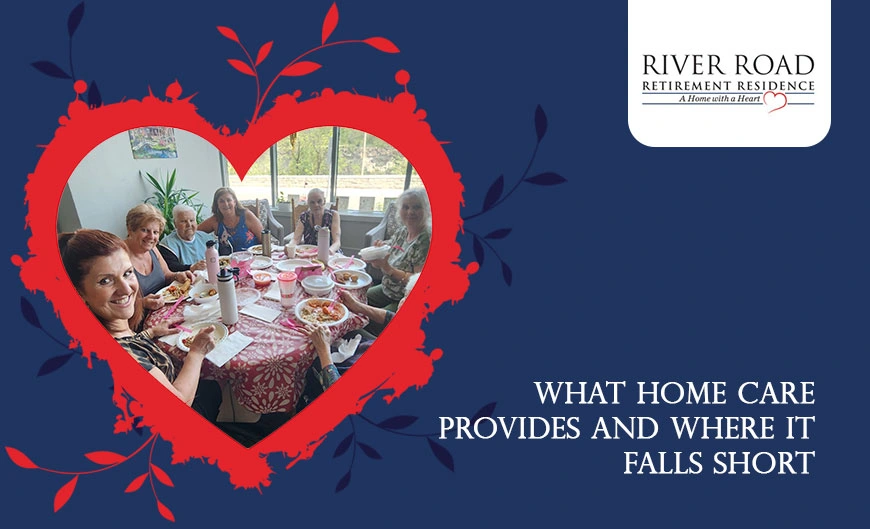
What Home Care Provides and Where It Falls Short
Home care tends to be where most families start, with a parent staying in a familiar environment. A personal support worker (PSW) comes in on a regular schedule to help with bathing, dressing, medication reminders, and meals, and, for a period, that can be enough. When a parent’s needs are mild, and the PSW visits cover the gaps, this arrangement genuinely works.
The difficulty in this setup is that needs rarely stay the same. As mobility of the concerned senior declines or cognitive changes begin to appear, the time between caregiver visits starts to matter far more than it once did. There are hours in the day, and long stretches at night, when no one is present. If something goes wrong during that time, the family is the first call, not a trained caregiver who is already there. Scheduled visits are built around routine, and your parent’s health does not always follow one.
What many families also do not expect in this case is the care coordination that falls on their shoulders. Managing multiple providers, arranging cover when a caregiver cancels, and keeping track of health changes from a distance is a significant and ongoing responsibility. It tends to grow gradually, so families often do not notice how much they are carrying until it becomes genuinely difficult to sustain.
What Assisted Living in Niagara Falls Looks Like
Assisted living is not the same as a long-term care nursing home, and that distinction matters more than most families in Niagara Falls realize.
Assisted living is designed for seniors who need meaningful daily support with their personal hygiene, medication management, and meals. But they do not necessarily require hospital-level medical intervention. Seniors live in private or semi-private suites within a residential community, where staff are not coming and going on a schedule. They are present at all times, as a permanent part of the environment.
Also, assisted living facilities are built to feel residential rather than clinical. They get to share dining rooms, comfortable common areas, and a consistent daily routine with other residents, which gives them a sense of structure and normalcy.
Apart from this, what sets this model apart is the quality of observation that comes with having staff present continuously. They notice the things that scheduled caregivers can miss, such as a drop in appetite, unusual confusion, or a subtle change in how a resident moves. That level of attentiveness can catch a health concern early, well before it becomes something more serious.
The Social Side of Senior Care: Why It Matters More Than Families Expect
Loneliness among aging adults is a more serious concern than it is often given credit for. Chronic social isolation among seniors affects cognitive health, emotional wellbeing, and physical health in ways that build up gradually and are not always easy to spot.
For a senior aging at home, daily social contact can shrink to a PSW visit in the morning and a phone call from a family member in the evening. That kind of limited interaction isn’t enough to sustain a person’s sense of connection with the world, and over time, the effects of that isolation tend to show.
In a seniors’ assisted living community, social engagement is built into the daily structure through shared meals, group activities, and seasonal events that form naturally among people navigating similar life stages. This is one of the clearest advantages of assisted living facilities for families in Niagara Falls concerned about a parent’s emotional and cognitive health. A genuine social community cannot be replicated by scheduling home visits more frequently.
Safety, Overnight Coverage, and Emergency Response
Falls are the leading cause of injury-related hospitalization among older adults in Niagara Falls and elsewhere in Canada, so consistent senior care is non-negotiable. The risk is highest for those living alone, particularly during overnight hours when no caregiver is present.
Home care can include safety modifications at home such as grab bars, non-slip flooring, and personal alert devices. These additions are helpful, but they are precautionary rather than protective. If a senior falls or has a health episode when no caregiver is present, the best outcome is that someone calls for help. It does not change the fact that no one was there when it happened.
In assisted living communities in the Niagara Region like River Road Retirement Residence, staff are active and present at every hour. We understand that response to an emergency is measured in minutes, not hours. Senior care settings with registered nursing support on site offer a level of clinical oversight that home care providers simply cannot match consistently.
What to Ask When Evaluating an Assisted Living Facility
When visiting assisted living facilities in Niagara Falls or elsewhere, families should look past the lobby and the brochure. For families considering a riverside old age home setting, speaking directly with current residents and their family members during a visit often surfaces information that a guided tour is unlikely to.
Key questions worth asking directly:
- Staff consistency: Do residents have the same caregivers on a regular basis, or is turnover frequent?
- Emergency protocols: What specifically happens when a resident has a health event overnight?
- Fee transparency: What is included in the monthly cost and what is billed additionally?
- Social programming: What activities are available, and do residents genuinely participate?
Evaluating assisted living facilities in Niagara Falls at different times of day gives families a much more accurate picture of what daily life actually looks like in a given community.
Every family’s situation is shaped by a parent’s needs, the family’s capacity to coordinate care, and what matters most to the aging person themselves. What holds true across most situations is that as care needs grow, home care’s limitations become progressively harder to work around. For families in Niagara Falls, assisted living communities are not a last resort. They are a deliberate, well-considered choice to give an aging parent consistent, connected care in an environment that is genuinely built around their well-being.
Frequently Asked Questions
- What is the difference between assisted living and a long-term care home in Ontario?
Assisted living is designed for seniors who need help with daily tasks—like bathing, meals, and medication management—without intensive clinical care. Long-term care homes in Ontario are government-regulated and serve those with complex ongoing medical needs. Assisted living typically offers more independence and a more residential atmosphere. - What does assisted living in Niagara Falls typically cost?
Fees vary based on the community, suite type, and level of personal care provided. Most communities offer a monthly rate that covers accommodation, meals, housekeeping, personal care, and programming. Families should always request a written, itemized fee breakdown before making any commitment. - How do families know when home care is no longer adequate?
Common indicators include repeated falls, difficulty managing medications without supervision, signs of cognitive decline, deepening social withdrawal, or a family caregiver reaching a point of exhaustion.
When the current arrangement consistently feels unsafe or unmanageable, exploring residential options is a practical and responsible step.
- Can a senior try assisted living before committing to a permanent move?
Some communities offer short-term respite stays, giving seniors and their families a chance to experience daily life in the facility before making a long-term decision. Families should ask directly about respite or trial-stay options when visiting any care community in the area. - What should families prioritize when choosing a Niagara Falls assisted living facility?
Beyond the building’s appearance, families should focus on staff consistency, how personal care decisions are made and communicated, emergency response outside regular hours, clarity of the fee structure, and the quality and frequency of social programming. Speaking with current residents and their family members during a visit tends to surface what marketing materials rarely mention.